Friday, 17 January 2014

Owl City and Doctor Who


Spoiler Alert: 
The following post contains various spoilers for different episodes from the new Doctor Who Series (1-7 and Day of the Doctor) and assumes a knowledge of the events in them. There is also reference to the 1996 Doctor Who film. I have tried to avoid spoilers for that, but have included some pictures from it.

It's probably a good thing that I have no skill at making "fan videos", because if I did, I'd be really busy right now. I was given my second Owl City CD for my birthday last month (All Things Bright and Beautiful), and the more I listen to it, the more it seems to make a perfect soundtrack for montage videos of Doctor Who clips. I had already observed this tendency with my other Owl City CD (Ocean Eyes), but this one (probably because of it's implicit Space theme) seems even more conducive to the task. Since I'd rather not insult anyone with my poor video skills, I give you instead a written summary of how each song might be depicted using scenes, stories or characters from Doctor Who. (Any one who feels so inclined is welcome to attempt making these videos for themselves - just make sure I get to see them when they're done.)

The Real World

It doesn't require much imagination to see how this song could be represented with Doctor Who imagery. The line "reality is a lovely place, but I wouldn't want to live there", could be applied to either the Doctor himself ("I've been running all my life"), or various of his companions trying to deal with the schism between the fast-paced adventure world of the Doctor and all of time and space, and the far more mundane, but in some sense "more real" world of their every day "doctorless" lives.

But I think the story best fitted to this song, is that depicted in the episodes Family of Blood and Human Nature. In this two-parter, the tenth Doctor makes himself human in order to escape a terrifying alien enemy family that are after him. In making himself human, he tricks even himself into believing a false backstory about his life (forgetting all his past life as the Doctor). As the disguised human John Smith, he falls in love with Joan Redfern, a nurse at the school where he teaches. When the deadly Family of Blood trace him down despite his disguise and attack the school, his companion Martha (who does remember when he was the Doctor) tries to get him to forsake his new-found human life and love and go back to being the Doctor so that he can defeat the enemy. It is an enormous struggle for John Smith to give up his imaginary life and return to (what seems to him a far less pleasant one, even if it is the real one).


Deer in the Headlights

I confess I didn't really like this song at first. That is until I found a video someone had already made using (part of) the song to tell the story of the Doctor and River. I realised then that it describes her perfectly, although if I were to make a video, I would do it a little differently.

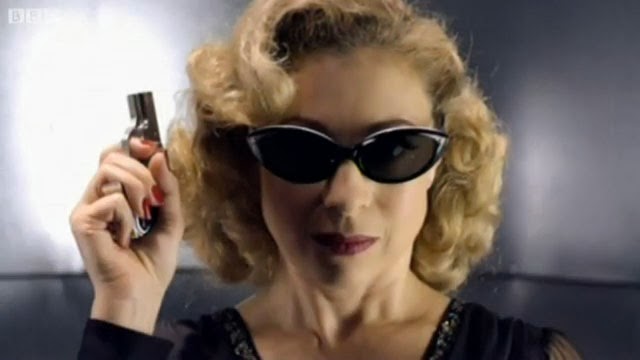
For the most part, a video to this song should contain scenes from Let's Kill Hitler. Selected scenes from The Impossible Astronaut/Day of the Moon, would also be suitable. For the first verse, the bit in the parking lot would need to be of Mels driving through the corn field and the line that about "pepper spray" of her holding up the gun to the Doctor.  The reference in the second verse to "black eyes and bloody nose" could be of River slapping the Doctor in The Impossible Astronaut or alternatively (and for greater emotional effect) her knocking him out in Forest of the Dead (just before she takes his place and sacrifices herself for him). In fact, there's probably time to fit both scenes in. The line "put your sunglasses on" would have to be the scene from Time of Angels where she jumps out of the Byzantium (wearing sunglasses) and is rescued by the Doctor. The line in the chorus "I never knew love could shine so bright" can make use of the scene where she saves him in Let's Kill Hitler, or the wedding kiss in Wedding of River Song.


Angels

This one seems pretty obvious. In fact it was probably this song that gave me the idea of making Doctor Who comparisons in the first place. There are two obvious things you can do with this song: use footage from Blink and tell the story of Sally Sparrow, or do a piece on Amy: either using scenes from Time of Angels/Flesh and Stone or make a farewell piece for her and Rory using Angels Take Manhattan. A combination of scenes from some or all of these would also work, and in fact, this has been done to great effect if you search on youtube.

As I was thinking over it, and listening to the song, however, it occurred to me that we could take this in a completely different direction. The angels in the song are meant to be more like traditional angels (and therefore good) and I was thinking of Madame Le Pompadour's title for the Doctor, "my lonely angel". I think someone could make a good video using this song to tell the story of the Doctor and Reinette. The line "flicker in the fake fireplace" could be accompanied by one of various scenes involving Reinette's fireplace. The reference to a note on the rocking chair that says "I've been dreaming of the life I once loved" could show the Doctor reading Reinette's final letter to him. "I believe there are beautiful things seen by the astronauts" could show the scene where the doctor pulls of the droid's disguise and comments on how beautiful it is.


Dreams Don't Turn to Dust

The obvious choice for this song, would be the episode "Amy's Choice". Not only is this episode about two different dream worlds (of which Amy thinks she has to choose which is the real one) but the decisive moment is when Rory is literally "turned to dust" by the creepy alien plants that have taken over the old people. Scenes in the sleepy countryside of Upper Leadworth, as well as of the freezing sun would fit in well with this song. The line "when diamonds boast that they can't be crushed" should show the doctor getting rid of the psychic pollen that caused the dreams in the first place. And the line "river blue", would have to have some sort of reference to River, even though she isn't in the episode.


Kamikaze

This song makes a good soundtrack for River and the Doctor's crazy relationship. What it needs is lots of random fast-paced switches between various fun and crazy scenes of the two of them. Some lines/clips that could match up:
  • "princess in her flower bed" - River as Cleopatra
  • "the jungle" - the Doctor and Amy reading River's rock inscription
  • "kamikaze over me" - River falling on top of the Doctor when he rescues her/River jumping off the building
  • "captain on a snowy horse" - the Doctor smashing the window on Arthur (okay, that's got nothing to do with River, but it's the right scene to use)
  • "not afraid to die alone" - River's death scene
  • "Midnight melody" - Well there are various options for that


Galaxies

The title of this song is enough to warrant a Doctor Who video and there are numerous things we could do with it. While I was listening, however, to the bit where they repeat the word "galaxy" in the background, I thought it would be cool if someone rerecorded a parody of the song that used the word "Gallifrey" in place of "galaxy". With that (and even without it) it would make a fairly good backing track to Day of the Doctor, for obvious reasons. Lines that would be appropriate to the story-line are "tick off the time bomb" (showing the moment/bad wolf/Rose), "kiss the planet goodbye", "when the galaxies crossed and sun went dark" and "saving grace of the galaxies [or Gallifrey]". Since the song refers directly to God in some places, I wouldn't mind a few other words being changed to make it more appropriate, though for the most part I think the original words could be kept.


Hospital Flowers

At first I couldn't think of anything for this song, and then I thought it might make a good soundtrack for the 1996 Doctor Who Movie with the (7th and) 8th Doctor and Grace. I know not everyone has seen the movie, so I won't go into specifics, but the fact that the line "Grace had finally found its way to me" appears in it makes it work well. And also, there just aren't enough 8/Grace videos out there.


Alligator Sky

There are two versions of this song (with and without a rap part). Either way, it needs to tell the story of someone "left behind" while another goes off on an adventure with the Doctor - "Where was I when the rockets came to life and carried you away into the alligator sky?"

So I thought it would make a good video of Donna and the Doctor's adventures from the point of view of Wilf, her grandfather. "I used to catch a cab on a Monday now now the taxi's selling lights on the runway," could be accompanied by scenes of the Doctor trying to rescue Donna from the runaway taxi in the TARDIS from Runaway Bride. Another option for this song would be to tell Mickey and Rose's story from Mickey's point-of-view (something I haven't seen yet).


I've left a couple of songs from the CD out because I couldn't come up with really good "stories" for them. The Honey and the Bee, might make a good Donna/Doctor video showing various scenes from their adventures. Plant Life might be fun to use for a montage of all different scenes from different episodes (the Doctor and Rose waltzing from The Doctor Dances, scenes from Hide or Army of Ghosts for the ghost references and scenes from The Runaway Bride for the reference to spiderwebs). I've struggled to come up with anything good for Yacht Club.

If you aren't familiar with the songs, you should be able to find most of them on You Tube. If you aren't familiar with the episodes - what are you waiting for? ;-)

Wednesday, 16 October 2013

The Magician's Nephew: Photographs

Summer Challenge '13


Forest of Dean, Gloucestershire


Beaumaris Castle, Anglesey


Worcester College, Oxford

The Magician's Nephew: Chapters 4-5

Summer Challenge '13: The Atlantis Connection

As I mentioned on the first day, I’ve always been fascinated by Atlantis and its role in the Narnia universe. And one of the things that’s puzzled me for a number of years is the fact that I’ve always associated it with Charn. When I read the description of Charn – old ornate stone buildings, terraces, the whole palace complex – it has the feel to it of descriptions of the lost continent. It has the feel of a society highly advanced, powerful and cruel. And then there’s the desolation. While it’s true that from the earliest myths, Atlantis was lost by drowning, the result is that most stories of its “discovery” involve the discovery of an ancient and now crumbling city (sometimes underwater, sometimes not) and Charn seems so accurately to mirror those depictions. After Jadis is awakened, my sense of connection between Atlantis and Charn grows, as we learn a little about the history and people and culture of Charn. She refers to slaves, sacrificial drums and terrible battle. And then there is Jadis’ story itself, so full of arrogance and the desire for absolute power. It was arrogance of this sort that led to the downfall and destruction of Atlantis in the old myths. The way Jadis’ ancestors are described as looking grimmer, prouder and crueller in the Hall of Images as time wears on, points to an increasingly arrogant society.

Yet despite all these connections, I’ve never been able to convince myself that there is any real link between Charn and Atlantis. There’s nothing in the story that suggests that there should be. The dust that Uncle Andrew uses to make the rings comes from Atlantis, and the Atlanteans somehow got it from the Wood Between the Worlds. The Wood has pools leading to all worlds, and Charn is just one of those many worlds. Ours is another. Charn is the one Digory and Polly arbitrarily pick to explore. There is no reason that Charn should be related to Atlantis any more than our world or Narnia. For these reasons I’ve never pursued the links that I noticed between the two.

But after reading the chapters that describe Charn, I’ve been thinking about it some more. And there might be a way of accounting for the links and attributing them to more than mere coincidence. I’ve often wondered whether the Atlantis to which Uncle Andrew refers was really another world; another world of which rumours had come to our world many years ago; rumours which had been passed down in legend. That at any rate would account for there not being any trace of it in our world today. But that introduces other problems, and Uncle Andrew talks of it as a civilisation in our world and by removing it from our world, we lose the legends of its wars with Greece and many other accounts in which it is really a civilisation of our own.

But what if Atlantis was indeed a civilisation in our world, but one that had links with another? A colony from another world? We know that the Atlanteans must have had the ability to travel between worlds (at least between our world and the Wood) and so if the people who settled Atlantis were really from another world that had the power of inter-world travel; could they not have set up a colony in our world? That would account for the advanced technology and skill that the Atlanteans possessed in so many versions of the myth.

And if Atlantis were a colony of another world, that world might have been Charn. That way we have an explanation for the similarities in architecture and culture and the apparent pride of the race, but maintain the more traditional accounts of Atlantis as a place in our world that was drowned when its people became too proud. In fact, I’d even suggest that what caused the downfall of Atlantis was an attempt by one among its people to use the Deplorable Word to gain a victory. We know Charnian magic doesn’t work in our world the way it does in Charn, so instead of destroying all living things, the uttering of the word destroyed only the continent of Atlantis, drowning it in the fury of the sea.

One problem still remains. It is purely coincidence that the world from which the Atlanteans originated was the exact same one that Digory and Polly chose to explore; coincidence that the society that had the dust from the Wood between the Worlds, originated from the one world that our heroes chose to visit. We could call it coincidence and leave it at that. Maybe it happened to be the pool closest to our own. Or maybe there was more going on. We know that Jadis set up the bell and hammer in the hopes that a magician would come and awaken her from sleep and take her to a new place that she could conquer. So perhaps her magic was at work beyond the realms of Charn itself, working in the Wood to draw Digory and Polly towards it. It was not coincidence, but Jadis’ spell that made them choose that pool. And why not? If the dust from the Wood from which the rings were made had belonged to those in Atlantis who were colonists from Charn, maybe magic of Charn could work through the dust and the rings. After all, perhaps, knowing something of the Colony of Atlantis, Jadis was hoping that it would be someone from Atlantis itself, a relation with similar magic, though one inferior to her, that would come and rescue her. Unfortunately Jadis’ plan went a little awry, and it was the non-magical nephew of a weak dabbler in magic, many generations since Atlantis itself was destroyed purely on the search for an adventure that woke her up instead.

Finally, I’d like to suggest that there were some survivors of Atlantis. Just a few. These, as suggested in Stephen Lawhead’s Taliesin, escaped by boat and arrived at last on some shore, perhaps England itself. These survivors, of a different race to ours, kept to themselves and had strange practises, even “magic” of a sort. They became the fair folk, or faerie of British legend. For the most part, they died out, but a few fell in love with humans from our world and married them. Generations later, the descendants of one of these survivors was Uncle Andrew’s godmother, Mrs Lefay. She really did have fairy blood in her, and it was by her connection with Atlantis that she inherited the small chest of dust from the Wood Between the Worlds.

The Magician's Nephew: Chapters 3-4

Summer Challenge '13: Digory Kirke

I’ve always thought of Edmund and Eustace as characters that start out quite nasty and then, through their adventures and encounters with Aslan, they develop and mature. I’ve never really thought of Digory as belonging to the same category as these two boys, but when you think about some of his actions in these two chapters, he has a good number of character flaws and, as others have pointed out, is not unlike his uncle. Don’t get me wrong, he’s much better than Uncle Andrew, seen clearly in the fact that he is willing to go and rescue Polly, when Uncle Andrew won’t even dream of going himself. But once he finds Polly, rather than getting her safely back home, he bullies her into exploring a different pool.

After coming up with the idea of exploring another world, he loses all sense of caution, and gets angry with Polly for resisting:

“Well even if you can-” began Polly, but Digory went on as if he hadn’t heard her.

Later he makes a fuss, even to agreeing to Polly’s plan to go halfway into their own world before trying another pool. He’s so annoyed about the delay, that he very nearly makes one of the most terrible mistakes of his life, by running off without marking which pool leads to our world. After this, he doesn’t apologise, but becomes all defensive arguing with Polly which leads to a several minute long quarrel between the two.

Once they arrive in Charn, Polly does not like it from the start, but Digory continues to ignore her feelings and cares only to satisfy his own curiosity. When Polly suggests they go home, Digory accuses her of cowardice to convince her into exploring with him.

And then they find the bell. It’s hard to know how much Digory is effected by the magic of the place and how much he is using it as an excuse to indulge his curiosity, but the following lines are telling.

“I expect anyone who’s come as far as this is bound to go on wondering until it sends him dotty. That’s the Magic of it, you see. I can feel it beginning to work on me already.

“Well I don’t, said Polly, crossly. “And I don’t believe you do either. You’re just putting it on.”


To which Digory retorts that she knows nothing ’cause she’s a girl.

Polly replies: “You looked exactly like your uncle when you said that,”

To which he replies: “Why can’t you keep to the point?...what we’re talking is-”

At this moment, Digory does not only look like his uncle, but he sound just like him. Remember Uncle Andrew used very similar phrases to Digory during their conversation about the rings? Whenever Digory brought up Polly’s safety, Uncle Andrew reprimanded him for going off topic, not sticking to “the point”. And yet here Digory does the exact same thing.

Another heated argument ensues between the children, Digory calling Polly a kid and Polly threatening to leave him behind. And then the crucial moment follows:

“None of that!” said Digory in a voice even nastier than he meant it to be [again sounding very much like his uncle]…

I can’t excuse what he did next except by saying he was very sorry for it afterwards (and so were a good many other people)…


He grabs and twists her hand (which hurt her quite a bit) and reaches for the hammer, striking the bell.

In this moment, his growing selfishness and lack of concern for Polly, reaches its climax, and he gives in to the temptation of the bell, which results in a great deal of harm to many people. But that’s well, another story (as a matter of fact a whole series of stories called The Chronicles of Narnia  ;-) ).

Don’t get me wrong, I don’t dislike Digory as a character. And like Edmund and Eustace he grows through his adventures and encounter with Aslan. While he doesn’t understand why Polly wants him to apologise on their return to England, by the end of the book, I’m sure he looks back on what he did and said to her in the Woods and Charn and regrets it very much.

But here I’ve highlighted some of his faults and the way his poor character and attitude led up to the moment where he struck the bell. There’s a thread on the forum about whether he sinned by striking the bell. I’m not sure quite how I feel about that, but if we look at his behaviour and attitude leading up to that moment, it seems that he was already on his way down a selfish path before he ever saw the tempting verse.

The Magician's Nephew: Chapters 1-2

Summer Challenge '13: Questions

One of the most intriguing and endearing things about Lewis’ writing is that he so often throws out random references to things he never elaborates on. Passing references that have little to do with the story, but when you stop to think about them, they point to countless other untold stories or adventures. Stories we catch only that brief passing glimpse of and are given nothing further; tantalising glimpses (in the literal meaning of the word). It is these that can often lead to fan fiction or other types of musings as people try to imagine what story might underlie that briefest glimpse.

There are a number of these in the first couple chapters of The Magicians Nephew. The first is Digory’s past. We learn that before coming to London, Digory lived in the country, in a house with an apparently large property with a river at the bottom of the garden and room for a pony whom he loved. This is all we get of his childhood before moving to London and yet it makes me wonder what amazing stories and adventures the young Digory must have had before his real adventures even began.

And then there’s Polly. Her life is fascinating and yet we get to learn so little about her family and background. It is only in these initial chapters that we get told a tiny bit; especially, the fact that she was a child with a vivid imagination and able to occupy herself during her recreational time most pleasantly. She had built for herself a secret “smugglers cave”; a place of retreat where she kept her treasures, and would retire to to enjoy a quiet bottle of ginger beer and to work on her story. Her story? Now how is that for tantalizing? Wouldn’t you, like Digory, just love to know what it was that she was writing? I wonder if she ever became a more accomplished writer; if in later life, she ever published anything? After her adventures in The Wood between the Worlds, Charn and Narnia itself, can you imagine the creative stories she might have written? I can just see her writing out an imaginary history of Charn.

Another question is about Digory’s dad. We know much about his mother, but very little about his father except that he was called away to India. My first guess is that he was a soldier called to serve in India which was still a British colony in those days. I suppose he also might have been some kind of government official or representative. Wouldn’t you just love to know what adventures he got up to in India? And what stories he must have had to tell his son coming back? I wonder if Digory was ever brave enough to tell his father that he’d been to places even further away than India?

Another mystery I don’t believe is ever solved (unless it is later in the book and I have simply forgotten) is what really lies in the empty house one over from Digorys. After all the build-up in the first chapter, it is a little bit disappointing that we never find out whether the house was haunted, secretly inhabited by someone who only came out at night with a dark lamp, if it was the den of a gang of criminals or if it really just had bad drainage. On the other hand it’s almost like Lewis does this on purpose. By keeping the empty house a mystery it remains appealing. If we knew the truth, it might turn out to be one of the uninteresting explanations grown-ups had and the story would lose some of its charm.

Another mystery is Uncle Andrew and his study. Although we know much about Uncle Andrew’s awful character and motivations, I’m really curious to know how he occupied his days before Digory and Polly stumbled upon his office. What was in all those books? He had a lot of them. We know a little, that he spent a lot of time and effort discovering what was in the box from Atlantis and how to make the rings, but what other tricks and experiments was he up to?

And probably the greatest and most tantalising question of all is who was Mrs Lefay and what in the worlds did Atlantis have to do with it all? I’ve loved the story of Atlantis for a long time, and especially since doing a module on it in one of my university classics courses. But Lewis tells us so very little. How did Atlanteans get dust from the Wood between the Worlds? What did they do with it (they hadn’t made it into rings)? How did it survive the downfall of Atlantis? How did Mrs Lefay get hold of it? How did Uncle Andrew figure out that rings were the way to make the dust work? How did he make the rings? So many questions never answered and left up to our imagination. Oh Lewis!

Mrs Lefay is especially interesting in light of the fact that (as someone years ago on TLC pointed out in a discussion thread) she shares her surname with an enchantress of Arthurian legend, Morgan LeFay. Did Lewis intend a direct connexion? We are told that she had fairy blood in her, and in old British legends the women like Morgan Lefay were associated with the faerie or fair folk (the “fay” part meaning something like “fairy”). Interestingly, in Stephen Lawhead’s Arthurian Pendragon Cycle, he equates refugees who escaped the downfall of Atlantis to Britain with the fair folk of such legends and people such as the Lady of the Lake, Merlin and a character that bears some resemblance to Morgan LeFay are Atlanteans and therefore faerie in his stories. I’m fascinated to know whether this is purely coincidence or whether Lawhead was drawing on a mythology that equated the faerie with Atlantis; a tradition Lewis himself was a acquainted with. I’d like to do some more research into this at some point, to see if there is anything to it. A last question regarding Mrs Lefay. Wouldn’t you love to know what she was imprisoned for?

So there we have it. The story has barely started and already Lewis has posed so many questions by hinting at elements of the story we never get to learn more about. But as I’ve suggested above, this is very much what makes Lewis such a good writer and this such a good book. It is full of mystery and much of the mystery must remain thus to add to the quality of the story. It is up to our imaginations and our unfortunately poorer skill (on my part anyway) to come up with our own answers to these questions and to explore these untold stories in more detail.

Tuesday, 5 February 2013

Trotter: A description of the development of the character Aragorn


Trotter was the name originally used for the character who would eventually become Strider (Aragorn) in J. R. R. Tolkien's The Lord of the Rings. This character underwent a series of developments and name changes before reaching his final identity. One of the things which was consistent throughout was the use of Trotter as his pseudonym. It was only after the story was complete that Tolkien decided to change it to Strider. It is important to note that Tolkien did not have the full plot of the story, or its background planned-out when he started writing. Rather, he “discovered” it as he wrote. This is the reason for the complex development of many of his characters.


Trotter the Hobbit

Trotter appears for the first time in the inn at Bree as a peculiar hobbit of whom very little is known. Trotter is initially described as "[A] queer-looking, brown-faced hobbit…He had an enormous mug…in front of him and was smoking a broken-stemmed pipe right under his rather long nose. He was dressed in dark rough brown cloth, and had a hood on in spite of the warmth, − and very remarkably, he had wooden shoes!"1 The innkeeper, Barliman Butterbur also refers to him as a “Ranger” (which at that time meant nothing more than “one of the wild folk”), who speaks little, but can tell fascinating stories. He is a frequent visitor at Bree, but no-one knows his real name.

Despite being nothing more than an outlandish hobbit, Trotter’s role in the early drafts concerning Bree is very similar to that of Aragorn (Isildur's heir) in the final text of The Lord of the Rings. He manages to persuade Bingo (which was the name given to Frodo at that stage of writing) that he is a friend of Gandalf, and leads the hobbits on the perilous journey from Bree to Rivendell.

Whilst writing, Tolkien was continually plagued by the question, “Who is Trotter?” This character, who had appeared from nowhere, had not been planned and yet he seemed to be someone of great importance. It would take a very long time before the answer to this question was settled in his mind.

After reaching the arrival at Rivendell for that first time, Tolkien got to a point where he was unhappy with certain elements of the story. Before going back and reworking the story from the beginning, he wrote down a series of notes entitled "Queries and Alterations".2 One of his notes suggested that the Rangers should not be hobbits as originally planned. This would mean that Trotter was not a hobbit either. He also suggested that if Trotter was a hobbit [who associated himself with the Rangers] he must be someone that is well known [to the other characters]. The latter suggestion was linked to an early comment which Bingo had made in Rivendell, saying that there was something familiar about Trotter. Tolkien made a proposal that he might be Bilbo Baggins himself, but quickly rejected that idea. The reason that Bilbo was not the main character in the sequel to The Hobbit was that it had ended with the line “he lived happily ever after to the end of his days…”.3 On this basis, Bilbo could not get involved in any further adventures.

Another suggestion was that Trotter was a hobbit named Fosco Took (later changed to Fosco Boffin), a relation of Bilbo’s who had vanished from the Shire. This suggestion was further considered the next time the question “Who is Trotter?” arose. Then, in a collection of notes entitled “New Uncertainties and Projections”, Tolkien wrote “Trotter turns out to be Peregrin, who had been to Mordor”.4 This was not the Peregrin Took (Pippin) of the final text, since the names of the hobbit companions were also undergoing various changes. The reference was to Peregrin Boffin, a nephew of Bilbo, who had mysteriously disappeared from the Shire when Frodo (now so called) was very young. (Gandalf and Bilbo had been blamed for his disappearance.)

The idea of Trotter as Peregrin Boffin was maintained for some time, making it into early drafts of Rivendell and beyond. It is also in Rivendell, that we are given a hint as to why the hobbit, Trotter, wore wooden shoes. While helping Gandalf hunt for Gollum, he had been captured by the Dark Lord and tortured. The nature of the torture is never revealed since, when he ceased to be a hobbit, the issue of the wooden shoes is no longer present or in need of explaining. The only further hint that Tolkien gives is a note in the margin which says that it would later be revealed that Trotter had wooden feet. This, however, never happens and is the last we hear of it.

Trotter the Elf

Tolkien stopped working on The Lord of the Rings for about a year. When he started again, he went back to the beginning, making various changes. (Christopher Tolkien refers to this as the ‘’Fourth Stage’’ of writing).5 In a note made before he continued, appears a remarkable, but short-lived idea. It suggests that “Trotter is a disguised elf, and friend of Bilbo’s”.5 It then goes on further to propose that he is a spy from Rivendell, sent out and pretending to be a Ranger. This idea, however, was not taken very seriously.

Trotter as a Man

As has been mentioned, Tolkien had from time to time had doubts about Trotter being a hobbit and had even thought he might be a man. In a note, which may have been written at the same time as the “elvish suggestion”, he considers this again. Here, for the first time, Trotter is given the name Aragorn. He is also called here “a man of Elrond's race”.7 Elrond, of course, is not an elf, but one of the Half-elven (or Peredhil), and is even described as such in The Hobbit, which had been published at that time. While the story of Númenor and the descendants of Elros (Elrond's brother) was not fully developed, the germs of it were in existence, and would come to be connected with The Lord of the Rings as the character of Trotter developed. The story of the heirs of Elendil, and Trotter’s connection with them, was still far from complete, but this was the beginning of what would become a very important part of the story and change the role of Trotter drastically.

The change did not come immediately, though. Tolkien even left Trotter as Peregrin Boffin, the hobbit, at the beginning of Stage Four. But not far into writing, he did change things and he finally became a man.

The next important steps in Trotter’s development occurred in the subsequent drafts concerning Bree. At first his physical description is the same as that given to Trotter the Hobbit, except that he is a man, and his wooden shoes are omitted. Gandalf’s letter which Frodo receives from Butterbur undergoes much development. At one stage, Trotter even has an accompanying letter from Gandalf to prove that he is who he says he is. In the first draft of his letter, he is called “Aragorn, son of Celeborn, of the line of Isildur”.8 This is the first time his connection to Isildur is mentioned. (Isildur and his association to the ring already existed, but his history and position were yet to be explained.) A significant development in Gandalf’s letter is that of the rhyme “All that is gold does not glitter.”
There are numerous versions of the rhyme. The first draft says:

All that is gold does not glitter;
all that is long does not last;
All that is old does not wither
not all that is over is past.9
In the next draft a number of new lines appear. The most significant are:
Not all that have fallen are vanquished,
A king may yet be without crown
A blade that was broken be brandished
and towers that were strong may fall down.10
The next version is very similar to that given above, except that it has “not only the crowned is a king” and the last line is “And fire the doom of the ring”. Christopher Tolkien suggests that the reference to the crownless king in these versions had nothing to do with Trotter at that stage. They were simply a “further exemplification of the general moral”11 of the poem which was that “things are not always as they seem”.

The broken sword, however, was significant, as this was the first mention of the shards of Narsil. In the final draft, Trotter would draw out the broken sword as proof of who he was.

The sword was to appear again at the council of Elrond (in the riddle of Boromir).12 At this stage, Boromir’s city was called Ond (not Gondor). Here Tolkien considers, for the first time, that Trotter’s fathers were kings there. But it would still be a long time before he would develop the history of Gondor and Arnor, and explain why the kings were now “exiles” in the North.

The development of Trotter’s connection to Ond was long and complex, as was his association with Boromir, the man from Ond. The relationship between Boromir (whose character was pretty much in the final form from the beginning) and Trotter was uneasy from the start. As Tolkien wrote, ideas came to him and the history of Trotter's ancestors developed. Much of this development took place in drafts of "The Council of Elrond" as the history of the Ring was being told.13 Initially it is said that Trotter's fathers were Númenórean kings who ruled over the non-Númenórean people of Ond. Sauron raised a rebellion and the citizens drove their kings out of the land. It had already been stated that Trotter was descended from Isildur, and Isildur was already connected with the Ring. In subsequent drafts the story developed further, till that of Elendil, his sons and the battle of the Last Alliance was properly reached. At one time, Tolkien seems to have conceived only three generation between Isildur and Trotter,14 but this was not maintained as it contradicted a number of previous statements implying that the battle of the Last Alliance had been a very long time ago.

Names

Tolkien had a great deal of trouble deciding what Trotter’s “real” name was. Although Aragorn was the first suggestion for his name as a man, it was changed a number of times between Bree and Lothlórien. It was altered from “Aragorn son of Celegorn” to “Elfstone son of Elfhelm” to “Ingold son of Ingrim”. Tolkien's main problem with the name “Aragorn” was that it was an “elvish” name and that would not do for Trotter who was a man.15 This was no longer a problem, however, when the book was finished, since the Númeróreans could speak Elvish, and gave their children elvish names. Surprisingly, Tolkien never explains the meaning of Aragorn, though most of his other names are explained.

When Tolkien reached the initial texts concerning Lothlórien, he was using the name Ingold for Trotter. But Galadriel's gifts would lead to another change. Originally, it was Gimli the Dwarf who would receive the green emerald (Elessar) from her. Gimli accepted the gift with the words “Elfstone shall be a name of honour in my kin for ever”.16 After writing this, Tolkien decided that he would rather change Trotter’s name back to Elfstone and that he would be the one to receive the emerald. On further revision, however, Tolkien decided to change his name again to Aragorn. Elfstone (translated as Elessar) became an assumed name, one which had been “foretold for him” (The Fellowship of the Ring, p 391). The name of his father was changed from Keleborn to Eldakar to Valatar and ...before reaching the final form, Arathorn.17

In the margin of drafts of the chapter entitled “The Last Debate”, Christopher Tolkien notes the presence of a remarkable passage. It is a conversation between Merry and Gimli in which Gimli says that the folk of Lebenin have been calling Trotter the “Lord of the Ring”.18 Merry thinks it must be a trick, to make Sauron think that Aragorn has and will use the One Ring. Gimli doubts this, saying that Aragorn would never allow such a rumour to be spread, even to trick the enemy, and that Elrond’s sons had also called him by that name. On another scrap of paper, is a note that says that Galadriel must give her ring to Trotter, but Tolkien immediately rejects this idea as it will leave Lothlórien defenseless.

Further Character Developments

From the time they left Lothlórien, the role and character of Trotter had almost been fully realized. He was to do and say much of the same things that Strider would in the final story; including leading the company from Moria, and choosing not to follow Frodo to Mordor.

One significant feature which did not yet exist, though, was his relationship with Elrond’s daughter, Arwen. This meant that when he first met Éowyn (Théoden's niece), the interest which she showed towards him was not one-sided.19 In notes, probably written after the first drafts of “King of the Golden Hall” chapter, Tolkien even suggested that Aragorn would marry Éowyn at the end of the story. He then had second thoughts, claiming that Aragorn was “too old, lordly and grim.”20 (He also makes an interesting comment here that Éowyn would be Éomer’s twin sister, but this idea did not survive either.) After this are other notes suggesting that Éowyn would die to save/avenge Théoden, and that Aragorn did love her after all, and would never marry after her death. This, however, was not the way things were to happen.

The first mention of Elrond's daughter is in reference javascript:;to the banner which she made for Trotter that his fellow Rangers brought to him in Rohan.21span style="mso-spacerun: yes;"> Her name is originally Finduilas (The name of an elf in The Silmarillion, and later that used for Boromir and Faramir's mother). Tolkien does not give any hint here as to why she made it, and whether she had any further part to play. The next mention of her is in a note (written during the “Houses of Healing” chapter) concerning Tolkien's plans for the end of the book. It says that Finduilas will come to Minas Tirith at the end.22 In the note referred to in the section on Names (about Galadriel giving Trotter her ring) we find a suggestion that the reason for this gift was that he was to marry Finduilas.23 It is only after the completion of the chapter concerning “Mount Doom” (i.e. after the destruction of the One Ring) that we hear of Finduilas again. In a sketch entitled “The Story Foreseen from Kormallen(sic)” Tolkien again outlines his plans for the rest of the book. Here it is said that Elrond, Celeborn and Galadriel will bring Finduilas to Minas Tirith after Trotter's coronation.24 There he and Finduilas will be married. The next point in this note says “also Faramir and Éowyn”. This is the first hint we have of their relationship, which may have simply developed out of their being “stuck together” in the Houses of Healing.

In the first draft of the “Steward and the King” (at the end of which Trotter is married) Elrond's daughter is still called Finduilas, and for the first time it is explained that she is Galadriel's granddaughter.25 In a manuscript text which followed this draft, her name is finally changed to Arwen. It is only in his working on the appendices of The Lord of the Rings that Tolkien records the full tale of Aragorn and Arwen to explain the events of the book.26

Why Strider?

Originally The Lord of the Rings was to have an epilogue, a final chapter in which Sam tells his children stories of his adventure.27 In the initial texts of this the king is still called “Trotter”, showing that the pseudonym was maintained right till the end. It was only on revision that Tolkien decided to change it to Strider. Why this decision was made is never explained. One can only guess that Tolkien realised Trotter had outgrown his name. What worked for an obscure hobbit with wooden shoes, did not quite work for the heir to the throne of Gondor, even if he was secretly living in exile.

All Trotter’s Names

Hobbits

Bilbo Baggins (short-lived idea)
Fosco Took/Boffin
Peregrin Boffin


Elvish

Translations of the Elvish form of Trotter, used by Glorfindel:
Padathir
Rimbedir
Duffinion
Ethellion Used by Bilbo, being the translation of “Peregrin”
Tarkil Used by Bilbo, meaning “Númenórean”
This was changed to Dúnadan in the final version
Tarakil Used by Trotter himself, being the Quenyan translation of “Trotter”
This was changed to Telcontar for “Strider” in the final version


Manish

Succession of names:
Aragorn → Elfstone → Ingold → Elfstone → Aragorn
Alternate versions of “Elfstone”:
Erkenbrand, Elf-friend, Elfmere, Elfspear, Elfwold
Alternate translations for “Elfstone”:
Eladamir → Eldavel → Eledon → Quendemir → Elessar


Rejected Title

“Lord of the Ring”


References

1. RS: 137-138. 
2. RS 
3. RS: ??.
4. RSw: 369-387. 
5. TI: 18. 
6. TI: 6. 
7. TI: 6-8. 
8. TI: 50. 
9. TI: 76. 
10. TI: 80. 
11. TI: 171. 
12. TI: 116 & 128. 
13. TI: 110-160. 
14. TI: 360-361. 
15. TI: 277-278. 
16. TI: 275 . 
17. TI: ??. 
18. WR: 425-426. 
19. TI: p 445. 
 20. TI: p 448. 
21. WR: 307. 
22. WR: 386. 
23. WR: 425. 
24. SD: 52. 
25. SD: 58. 
26. PME: 262-270. 
27. SD: 114-135. 

References

RS: The Return of the Shadow, J. R. R. Tolkien (1988), Christopher Tolkien, (ed.), Boston: Houghton Mifflin.  

TI: The Treason of Isengard, J. R. R. Tolkien (1989), Christopher Tolkien, (ed.), Boston: Houghton Mifflin. 

WR: The War of the Ring, J. R. R. Tolkien (1990), Christopher Tolkien, (ed.), Boston: Houghton Mifflin. 

SD: Sauron Defeated, J. R. R. Tolkien (1992), Christopher Tolkien, (ed.), Boston: Houghton Mifflin. 

PME: The Peoples of Middle Earth, J. R. R. Tolkien (1988), Christopher Tolkien, (ed.), Boston: Houghton Mifflin.

Saturday, 12 January 2013

Birthday and Christmas Photos (2012)

This post contains photos of my Christmas and birthday presents mainly for the benefit of my family back home so they can see what I got. I've also included the birthday cake Averil made for me and a photo of my nissermen (Danish Christmas elves)

Christmas: Cross-stitch from Averil and Louis, Christmas Cake from Averil, Reindeer choc from Louis, Hobbit mug, alarm clock and string bookmark from Myriam, Hedgie-thimble from home


Birthday: Hand-cream from Averil and Louis (top left), card wallet from Myriam (bottom right), hedgie scarf, hair things, jewellery and face-cloth from home


Averil's cake and cross-stitch close-up


Close-up of Hobbit mug


Back of Hobbit mug


Close-up of thimble


From Kristi (owner of TLC): Hedgehog finger puppet from Las Vegas, Echidna 5c coin from Australia, Hobbit stamp from New Zealand and home-made moulded chocolates


Close-up of finger puppet, coin and stamp


Detail on coin


Moulded chocolate - Lucy of Narnia's magic cordial


Moulded chocolate - Hobbit acorn buttons


Birthday cake made by Averil


Home-made nissermen (traced on red card from computer print-out)